How AI Shopping Agents Decide Which Products to Recommend
AI shopping agents recommend the products whose data best answers the shopper's request and that they can describe with confidence. No platform publishes its formula, but OpenAI, Google and Shopify all document what they read: titles, descriptions, attributes, variants, prices, availability, reviews and policies. A product that states the fact the shopper asked about, at a current price, in stock, is the one an agent can stand behind.
We call that agent confidence. This guide breaks a shopping request into the stages an agent works through, cites what each platform says at each stage, and shows where product listings win or lose. Sources are linked inline and were checked on October 29, 2026.
What Shoppers Ask Agents to Do
Start with the job. In 40rty's October 2026 survey of 1,614 US online shoppers, those likely to use AI for holiday shopping most often wanted it to find the best deal on a product (64%), track price drops (59%), compare similar products (59%) and check whether something is in stock (40%). Only 20% wanted it to buy on their behalf. Today's agent is mostly a comparison engine, and comparison runs on data.
The Five Stages of a Recommendation
This is our working model, not a published algorithm. Each platform implements it differently, but every shopping answer has to get through these steps:
| Stage | The agent's question | What it reads |
|---|---|---|
| 1. Understand | What does the shopper actually need? | The prompt, the conversation so far |
| 2. Retrieve | Which products could fit? | Catalog and feed data, crawled pages, related searches |
| 3. Filter | Which ones meet the hard constraints? | Price, availability, size, color, category, shipping |
| 4. Compare | Which fit best, and why? | Descriptions, attributes, materials, dimensions |
| 5. Trust | Can the agent stand behind this pick? | Reviews, return policy, store policies, consistency |
1. Understand the Prompt
Shoppers describe a need, not a product: “a gift for a runner who has everything, under $80.” The agent turns that into attributes, a price ceiling and a category. If your listing never says who the product is for, it has nothing to match.
2. Retrieve Candidates
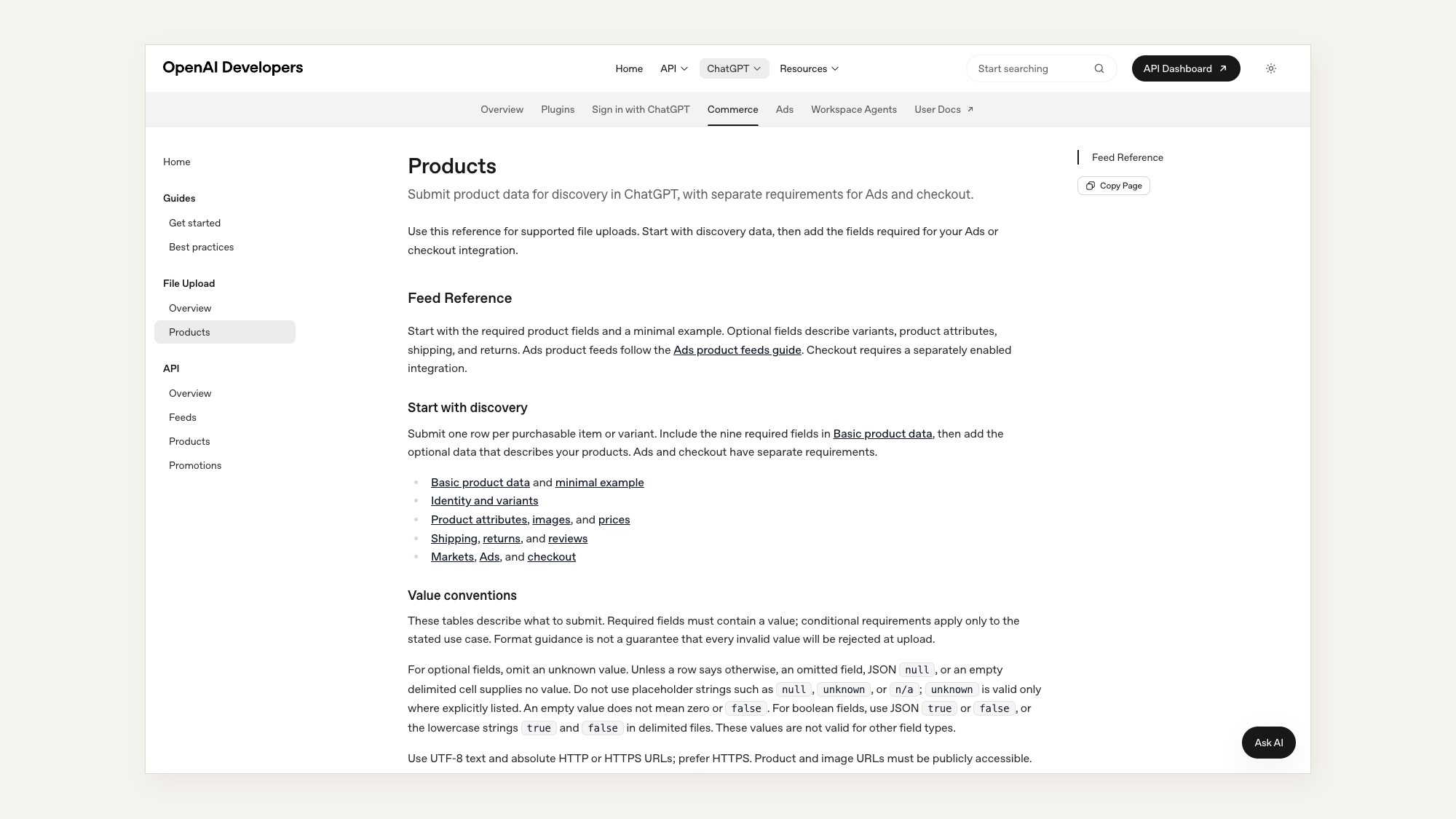
Agents pull candidates from product catalogs and the web. Shopify sends eligible stores' products to AI channels through Agentic Storefronts and Shopify Catalog. Google's AI features guidance says AI Overviews and AI Mode may use “query fan-out,” issuing several related searches across subtopics and data sources to build one response. OpenAI's crawler docs say sites that block OAI-SearchBot won't be shown in ChatGPT search answers. A product that isn't retrieved can't be recommended, however good it is.
3. Filter on Hard Constraints
Price, availability, size, color and shipping are pass or fail. OpenAI's commerce docs say required feed fields exist so price and availability display correctly. Shopify lists variants with option names among the details AI platforms consider. This is also where agents fail shoppers most: across all 1,614 people in our survey, 25% said AI had got a price wrong and 20% said it had got stock wrong.
4. Compare What Is Left
The agent now compares a handful of products on attributes: material, dimensions, fit, compatibility. It can only use what is written. OpenAI's product feed spec has fields for material, color, size, gender, age group, dimensions and weight. On Shopify these live mostly in category metafields. A product that leaves an attribute blank loses every comparison on that attribute.
5. Check Trust
Before an agent names a product, it needs reasons to believe it. OpenAI says recommended attributes such as rich media, reviews and performance signals improve ranking, relevance and user trust, and its spec includes review count, star rating and return policy fields. Shopify says complete store policies let an agent answer a return question with the information you stored. The spec also says search eligibility “does not guarantee display”: being in the catalog is the start, not the result.
Why the Same Product Wins One Prompt and Loses Another
Recommendation is per prompt. A jacket can win “lightweight rain jacket for travel” and be invisible for “packable waterproof jacket under 300 grams” because its weight isn't stated. That is why we track prompts, not keywords. It is also not one agent: in our survey, 52% of US online shoppers had used Google Gemini or AI Mode in the past three months and 50% had used ChatGPT, ahead of Microsoft Copilot (22%) and Meta AI (19%).
What Losing Looks Like
Two in three AI shoppers in our survey had seen AI get product information wrong. Of those, 37% bought from another brand or store, 28% didn't buy at all, and 31% bought anyway after checking. The upside runs the other way too: 38% of AI shoppers have bought from a brand AI introduced them to.
How to Earn the Recommendation
- Write for the prompt. Say who the product is for and what problem it solves, in plain words.
- Fill every attribute. Product category, category metafields, variants with clear option names, barcodes.
- Keep price and stock live. Put sale prices in product data, not only in banners.
- Show proof. Reviews, a clear return policy, complete store policies.
- Stay crawlable. Allow OAI-SearchBot and keep pages indexable.
For ChatGPT specifically, see how to rank in ChatGPT. For the protocols that handle the cart once a product is chosen, see the Universal Commerce Protocol. For the content side of answer engines, see what AEO is, and skip a new llms.txt: Shopify already serves one.
The agent doesn't pick the best product. It picks the product it can best explain. Make yours easy to explain.
FAQ
How do AI shopping agents choose which products to recommend?
No platform publishes its formula. What OpenAI, Google and Shopify document is the data they read: product titles, descriptions, attributes, variants, prices, availability, reviews and policies. Agents match that data to the shopper's request, drop products that fail a constraint, compare the rest and recommend the ones they can describe with confidence.
Do reviews affect AI product recommendations?
OpenAI says recommended feed attributes, such as rich media, reviews and performance signals, improve ranking, relevance and user trust. Its product feed spec includes review count and star rating fields.
Can I pay to be recommended by AI shopping agents?
Some platforms run ads alongside organic results. OpenAI's product feed spec includes an is_ads_eligible flag, separate from search eligibility. This guide covers organic recommendations only.
Why does AI recommend my competitor and not me?
Usually because the competitor's product data answers the shopper's prompt more completely: the attribute the shopper asked for is stated, the variants are clear, and price and stock are current. Check your listings against the exact prompts shoppers use in your category.
What do shoppers ask AI shopping agents to do?
In 40rty's October 2026 survey, shoppers likely to use AI for holiday shopping most often wanted it to find the best deal on a product (64%), track price drops (59%), compare similar products (59%) and check stock (40%). 20% wanted it to buy on their behalf.
Check Your Store
The free 40rty audit scores a storefront's agentic commerce readiness, with no install and no account. Agents and developers can call it at GET https://audit.40rty.ai/api/audit?domain=<store>.
AgentIQ by 40rty builds agent confidence in your product listings, so AI shopping agents rank, recommend and add them to cart. It finds the shopping prompts your products should win, tracks where they rank in Shopify Catalog and rewrites listings around those prompts. Plans are Small $49 a month (50 products), Pro $149 (1,000), Grow $499 (10,000) and Autopilot $799 (unlimited), per the App Store listing. Cheaper apps cover parts of this; our comparison of Shopify AEO and GEO apps says which.