The Agentic Commerce Protocol (ACP): A Guide for Shopify Merchants
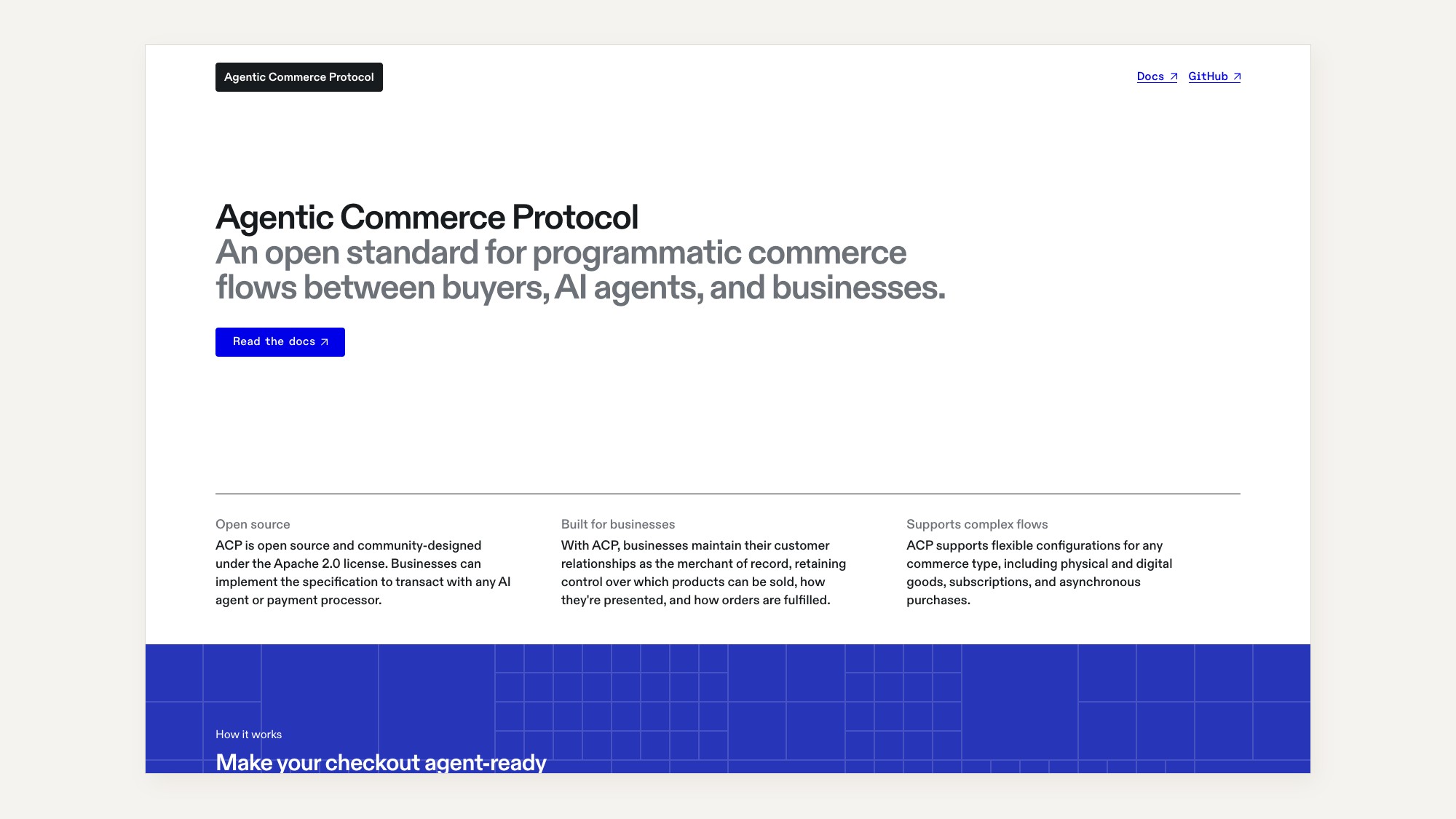
The Agentic Commerce Protocol (ACP) is an open standard for how AI agents and businesses transact, including checkout and securely sharing payment details. Stripe and OpenAI developed it, it is licensed under Apache 2.0, and it powers Instant Checkout in ChatGPT.
For most Shopify merchants, the short answer is that there is nothing to build. Shopify sends your products to ChatGPT through Shopify Catalog. What ACP does tell you is what ChatGPT wants from a product listing, and that part applies to every store. Sources are linked inline and were checked on October 29, 2026.
The Three Parts of ACP
OpenAI's key concepts page says supporting Instant Checkout in ChatGPT requires a merchant to implement three flows:
- A product feed. A secure, regularly refreshed CSV or JSON feed with identifiers, descriptions, pricing, inventory, media and fulfillment options, so ChatGPT can surface products accurately. Integration starts with a sample feed for validation, then daily snapshots.
- The Agentic Checkout Spec. ChatGPT collects buyer, fulfillment and payment information and calls the merchant's ACP endpoints to create or update a checkout session. The merchant validates the order, determines fulfillment options, calculates tax, charges the payment with its existing processor, and accepts or declines the order.
- The Delegated Payment Spec. OpenAI prepares a one-time payment request with a maximum amount and an expiry, and the merchant's payment provider returns a token the merchant uses to complete the payment. OpenAI names Stripe's Shared Payment Token as the first compatible implementation.
Two lines in OpenAI's docs matter most to a merchant. OpenAI is not the merchant of record: checkout state and payment processing happen on the merchant's systems. And while building with ACP is open to all, Instant Checkout in ChatGPT is currently available to approved partners.
What ACP Means on Shopify
Shopify's ChatGPT page describes ChatGPT as a discovery-focused referral channel. Your products reach it through Shopify Catalog, and you don't need to do anything for that. When a shopper decides to buy, they complete the purchase on your online store checkout, in ChatGPT's in-app browser or a new tab. Shopify's page doesn't mention ACP, and Shopify doesn't ask merchants to build an ACP integration.
To appear, Shopify requires that you sell to customers in the United States, that your products are eligible for Shopify Catalog, that you agree to the Agentic Storefronts Supplemental Terms, and that your terms of service, privacy policy and refund policy are complete. The full setup is in our Shopify Agentic Storefronts guide.
ACP vs UCP
The Universal Commerce Protocol is the other open standard in this space. They overlap on checkout and differ on scope and backers:
| Aspect | Agentic Commerce Protocol | Universal Commerce Protocol |
|---|---|---|
| Developed by | Stripe and OpenAI | Google, with Shopify and others as co-developers |
| License | Apache 2.0 | Apache 2.0 |
| Covers | Product feed, checkout, delegated payment | Catalog search, carts, identity linking, checkout, orders |
| Where it runs | Instant Checkout in ChatGPT | Google's first implementation: buying in AI Mode and Gemini |
| On Shopify | No action documented; ChatGPT gets products through Shopify Catalog | Storefronts already publish a UCP profile |
Neither protocol ranks products. They agree on how a cart and a payment move between an agent and a store. Which product goes into the cart is decided earlier, from product data.
The Part That Applies to Every Store: The Feed
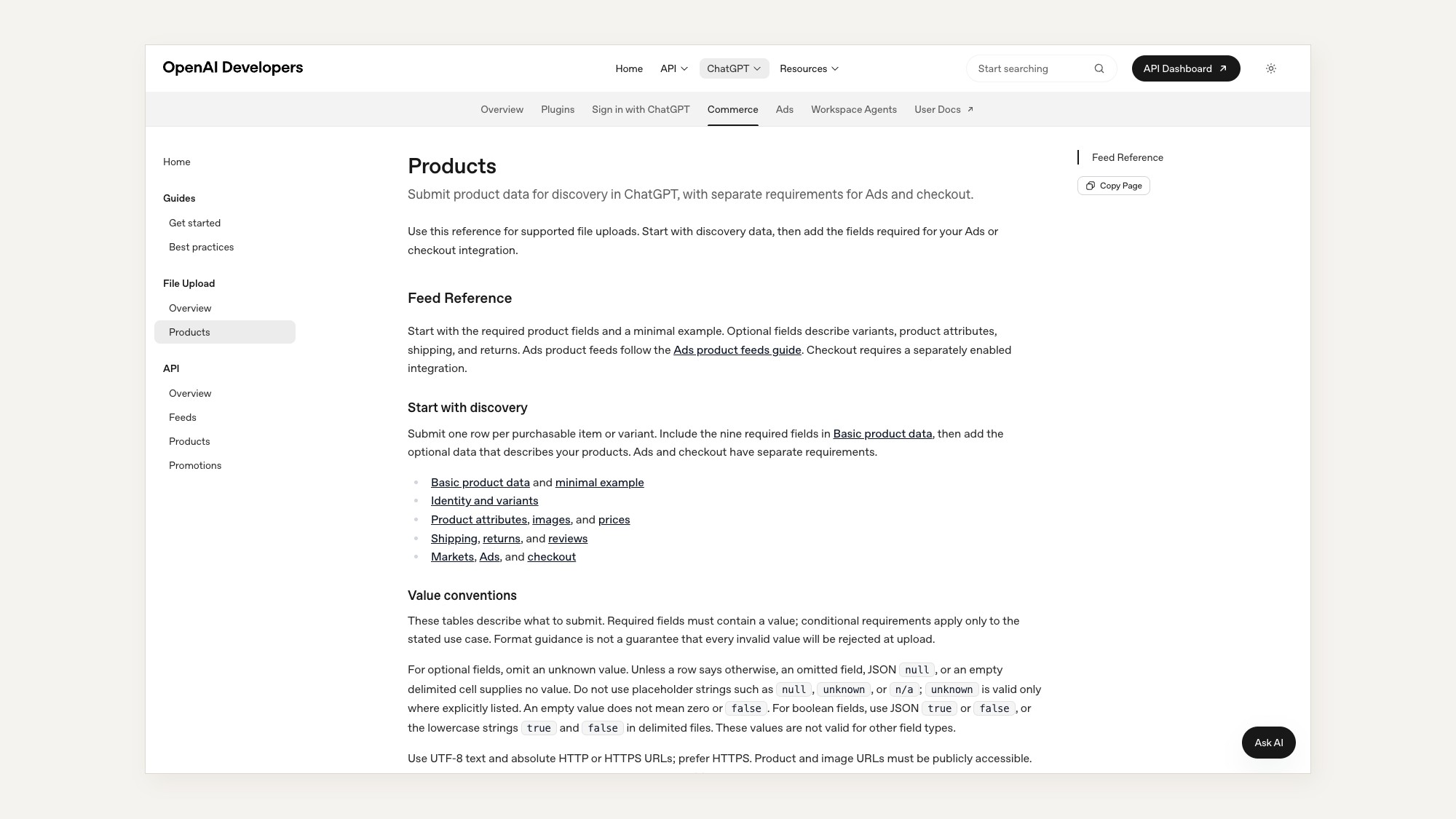
OpenAI's docs say required feed fields make price and availability display correctly, while recommended attributes, such as rich media, reviews and performance signals, improve ranking, relevance and user trust. The product feed spec is the most concrete public description of what a ChatGPT product listing is made of. Even if Shopify Catalog builds your feed, it is a useful checklist:
- Required basics: item ID, title, description, URL, brand, seller name, image, availability and price.
- Variants: a group ID and a variant dictionary that names each option, plus GTIN and MPN where you have them.
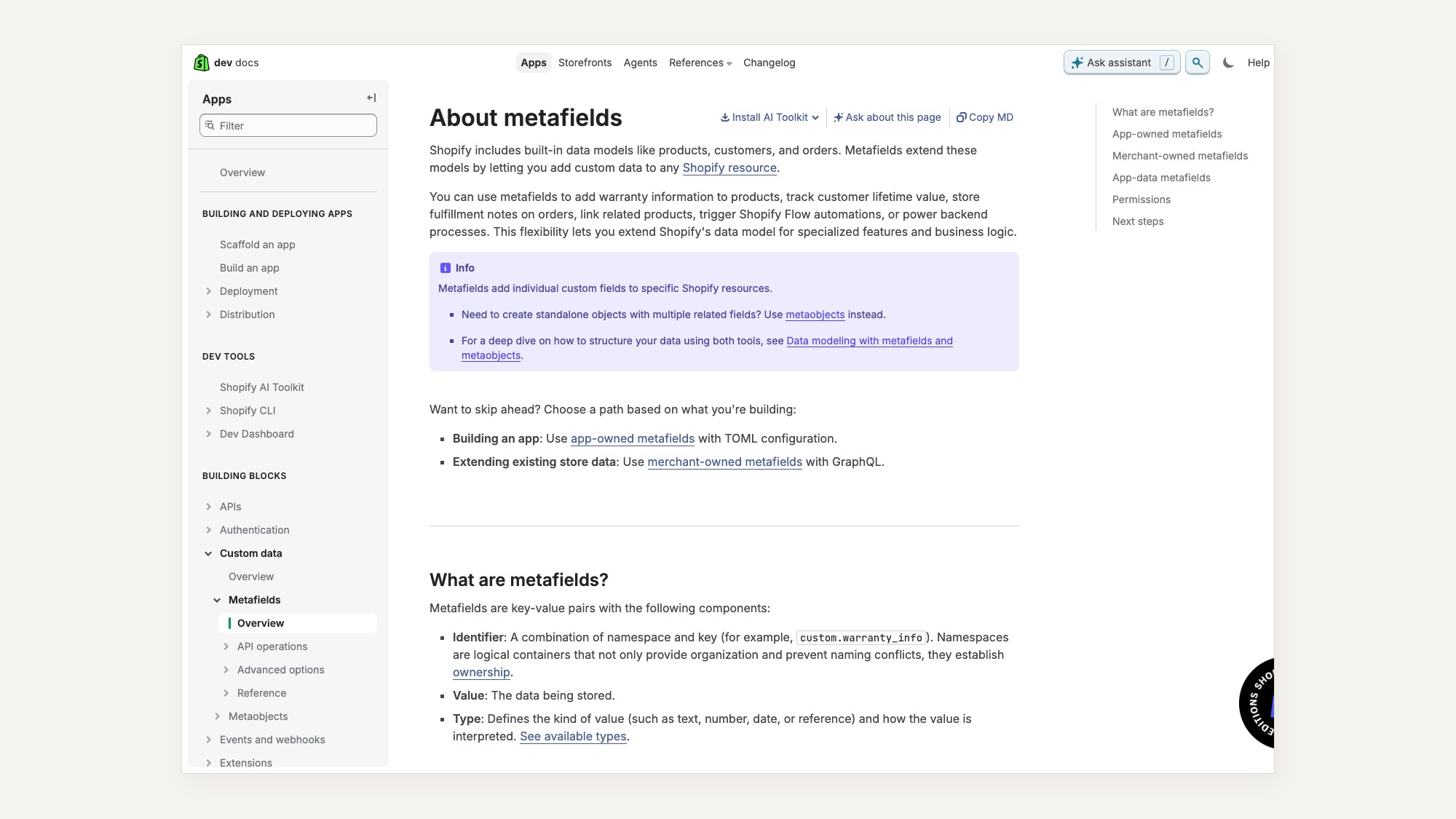
- Item details: product category, material, color, size, gender, age group, dimensions and weight. In Shopify these mostly live in category metafields; see Shopify metafields for AI agents.
- Trust: return policy and return window, review count and star rating.
The spec also notes that search eligibility “does not guarantee display.” Being in the feed gets you considered. Complete, accurate data is what gets you chosen. It matters to shoppers too: in 40rty's survey of 1,614 US online shoppers, two in three AI shoppers had seen AI get product information wrong, and 65% of them walked away from the purchase.
When to Build an ACP Integration Directly
A direct integration makes sense if you run your own commerce stack and want Instant Checkout in ChatGPT, and you are accepted as an approved partner. OpenAI's docs also describe a direct path for payment providers and PCI DSS level 1 merchants with their own vault. For a Shopify brand, the higher-return work is the data the feed carries. For how ChatGPT uses it, see how to rank in ChatGPT; for the wider shift, see agentic commerce for Shopify brands.
The protocol is plumbing. The pitch still travels through the pipes, and that part is yours to write.
FAQ
What is the Agentic Commerce Protocol?
The Agentic Commerce Protocol (ACP) is an open standard for commerce between buyers, AI agents and businesses, developed by Stripe and OpenAI and licensed under Apache 2.0. OpenAI's documentation describes three parts: a product feed, an Agentic Checkout Spec and a Delegated Payment Spec.
Who is the merchant of record under ACP?
The merchant. OpenAI's documentation says OpenAI is not the merchant of record: the merchant validates the order, calculates tax, charges the payment with its own processor, and accepts or declines the order on its own systems.
Can any merchant use Instant Checkout in ChatGPT?
Not yet. OpenAI says building with the Agentic Commerce Protocol is open to all, but Instant Checkout in ChatGPT is currently available to approved partners, who apply through a form.
Do Shopify merchants need to implement ACP?
Shopify's Help Center says you don't need to do anything for ChatGPT to discover your products through Shopify Catalog, and that ChatGPT shoppers complete their purchase on your online store checkout. Shopify's documentation doesn't ask merchants to build an ACP integration.
What is the difference between ACP and UCP?
Both are open standards for agents to buy from businesses. ACP was developed by Stripe and OpenAI and centers on a product feed, checkout and delegated payment. UCP was announced by Google with Shopify among its co-developers and covers catalog search, carts, identity linking, checkout and orders.
Does ACP decide which products ChatGPT recommends?
No. ACP defines how products, checkouts and payments are exchanged. What it does say is that recommended product attributes, such as rich media, reviews and performance signals, improve ranking, relevance and user trust.
Check Your Store
The free 40rty audit scores a storefront's agentic commerce readiness, with no install and no account. Agents and developers can call it at GET https://audit.40rty.ai/api/audit?domain=<store>.
AgentIQ by 40rty builds agent confidence in your product listings, so AI shopping agents rank, recommend and add them to cart. It finds the shopping prompts your products should win, tracks where they rank in Shopify Catalog and rewrites listings around those prompts. Plans are Small $49 a month (50 products), Pro $149 (1,000), Grow $499 (10,000) and Autopilot $799 (unlimited), per the App Store listing. Cheaper apps cover parts of this; our comparison of Shopify AEO and GEO apps says which.