E-commerce Killed the Salesperson. AI Is Bringing Them Back.
The shift from human shopping to agentic commerce is already underway. Here is what it means for merchants, and what to do about it.
There is a behavioral shift happening in e-commerce that most merchants have not fully processed yet. It is not just that shoppers have less patience, though they do. It is not just that mobile changed how people interact with product pages, though it did. The change is more fundamental: the human shopper is starting to leave the building.
Not literally. But the person who once scrolled your homepage, read your product descriptions, compared specs, checked reviews, and eventually added something to cart? That person is increasingly handing those tasks to an AI agent, telling it what they need, and asking it to come back with an answer.
This is not science fiction. It is happening right now.
From Browsing to Hunting to Delegating
A few years ago the dominant shift in retail behavior was simple but important: users stopped browsing and started hunting. They arrived at a store with a specific mission. “Find it. Get it. Done.” Decision fatigue had become real, attention spans had collapsed, and the discovery experience that e-commerce was built on started feeling like friction.
As Devarshi Acharya, a digital commerce strategist at Techincisive, put it in a widely-shared piece on this trend: “Customers don't want options. They want certainty, quickly.” The platforms that adapted built better search, smarter recommendations, and cleaner category structures. The old rule was “show more products.” The new rule became “help users decide faster.”
Now that shift is going one step further. AI agents are beginning to do the shopping themselves. Instead of a human browsing a product catalog, an agent parses it. Instead of a human comparing options, an agent evaluates them. The consumer's role shifts from active shopper to decision manager. They set the parameters, approve the final call, and let the machine handle the rest.
A 2025 study from researchers at Columbia Business School and Cornell described what this looks like in practice: “Online marketplaces will be transformed by autonomous AI agents acting on behalf of consumers. Rather than humans browsing and clicking, AI agents can parse webpages or leverage APIs to view, evaluate and choose products.”
For merchants, this changes who, and increasingly what, is on the other side of the transaction.
AI Agents Are Not the Rational Shoppers You Might Expect
The first instinct many merchants have when they hear this: great, that means the best product wins. No more games with visual placement or brand storytelling. Pure, objective comparison, and the best listing takes the sale.
That is not what the research shows.
AI agents do not shop like calculators. They shop like someone who learned everything they know about shopping by reading an enormous amount of human behavior. A study published at ICLR in early 2026, which ran controlled experiments placing AI agents in realistic shopping environments, found something striking: “agents are strongly biased choosers even without being subject to the cognitive constraints that shape human biases.” The agents responded predictably to price anchoring, star ratings, and psychological nudges. The same signals that influence human buyers influence AI agents too, and sometimes more reliably.
The implication the researchers, led by Manuel Cherep and Pattie Maes at the MIT Media Lab, drew was direct: “agentic consumers may inherit and amplify human biases.”
There is also a concentration effect worth understanding. When AI agents shop a category, they do not spread choices across an assortment the way human browsers do. They converge on a small set of products and ignore everything else almost entirely. The same Columbia/Cornell study called this “choice homogeneity.” For brands competing in crowded categories, the gap between being the product an agent recommends and the product it overlooks could be larger than the gap between ranking first and third on Google.
And there is volatility. When AI providers push model updates, market share can reshuffle dramatically and fast. A product consistently surfaced by one version of an agent may disappear from its recommendations entirely after an update. This is not like an algorithm change that takes weeks to ripple through. It can happen overnight, with no warning signal.
Trust Is Earned Through Two Different Doors
None of this plays out at scale until consumers actually trust these systems. And that trust is more complicated than it looks.
Research published in the Journal of Consumer Behaviour by Maria Petrescu at Embry-Riddle Aeronautical University and Anjala Krishen at the University of Nevada found that consumers evaluate AI through two routes at the same time. The first is cognitive: does this actually work, and is it transparent about how it decides? The second is affective: does it feel safe? Does it feel like it has my interests at heart, not the store's? Both have to be satisfied. Meeting only one is not enough.
What is particularly interesting is the concept of “deferred trust.” Some consumers trust AI shopping agents specifically because they distrust human salespeople. A salesperson has a commission. A brand has an agenda. An AI, in the consumer's mind, is at least free from those particular pressures. This is a real opening for brands that can credibly position their AI experience as genuinely on the shopper's side.
The same research draws a distinction between mechanical AI, which handles tasks but feels transactional, and what some researchers call “feeling AI,” which uses conversational tone and appropriate warmth to make users feel understood. The latter builds trust faster and keeps users engaged longer. Whether the person feels like the system is with them or just processing them turns out to matter a lot.
The Autonomy Paradox: People Want to Delegate, But They Also Want to Stay in Charge
There is a tension at the heart of agentic commerce that no one has fully solved yet.
When you hand your shopping to an AI, you feel a small but real loss of control. The more capable the agent, the more you depend on it. The more you depend on it, the more you feel like you have given something up. Add to this the data dimension: for an AI agent to shop well for you, it needs to know a lot about you. And knowing it knows a lot can feel uncomfortable, even when you are the one who shared the information.
Psychologists have a name for this. Autonomy, the feeling of being the author of your own decisions, is not a luxury. It is a core human need. Agentic commerce runs directly into it.
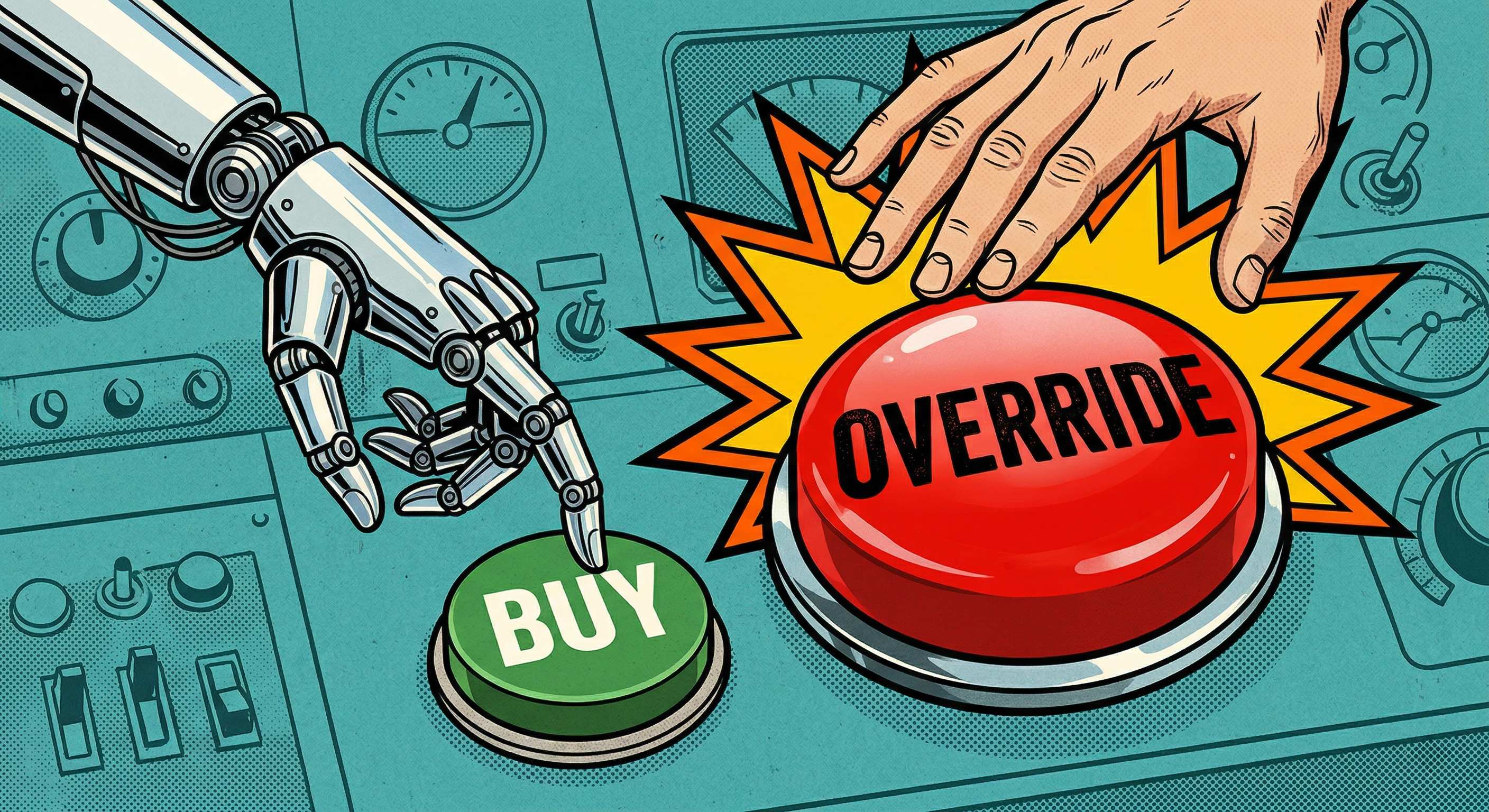
What actually works is giving the user visible control alongside the automation. Spending caps. Override buttons. An explanation of why the agent chose what it chose. When people feel like they can see what is happening and step in if they want to, the discomfort drops. The brands that win in agentic commerce will not be the ones that automate the most. They will be the ones that make people feel comfortable with the degree of automation they have.
The Store Has Not Changed. That Is the Problem.
For most merchants, the storefront has not meaningfully changed in ten years. A product page is still a product page: images at the top, description below, specs in a table, reviews at the bottom. Maybe a chatbot widget in the corner.
That format was designed for a human who had time to read, scroll, compare, and decide on their own terms. It was built for browsing.
When an AI shopping agent arrives, whether a human using an AI agent or an agent acting more autonomously, that format is the wrong interface. The shopper arrives with a specific intent. They have already done some version of research. A static brochure page is not what they need. They need something that meets them where they are, understands what they are trying to accomplish, and helps them close the gap between intent and decision as fast as possible.
A static product page cannot do that. It cannot ask a clarifying question. It cannot adapt what it shows based on what someone is actually looking for. It cannot explain why a particular product is the right answer for this specific person right now.
McKinsey's research on generative AI identified retail and e-commerce as among the highest-impact sectors precisely because the gap between what shoppers need and what current storefronts provide is so wide. The opportunity is not about adding another feature. It is about rethinking the format entirely.
Where Technology and Human Behavior Meet
Look at all the research in this piece together - the biases, the trust conditions, the need for visible control - and a pattern emerges. Shoppers have always wanted the same thing. They wanted someone to understand what they were looking for and point them at the right answer. E-commerce never quite delivered that.
Before e-commerce, a good salesperson in a physical store did something simple. They asked what you were looking for. They listened. They picked something off the shelf and said: this one, for this reason, for someone in your situation. You could push back. They could adjust. The decision happened through a conversation, and at the end of it you felt like someone had actually helped you.
E-commerce scaled the store but lost the conversation. It replaced the salesperson with a search bar and a filter panel, and asked the shopper to do the work of figuring out which of ten thousand results was right for them. Browsing was the workaround. Scrolling and comparing was how shoppers compensated for the absence of guidance.
AI changes the speed of that process but not the gap. An agent that shops on your behalf and returns an answer is faster. But an answer without explanation is still a black box. A recommendation you cannot interrogate is still an experience built around the store's convenience, not the shopper's confidence.
The next version of commerce starts with intent, not inventory. It asks questions instead of presenting options. It explains its reasoning, so the shopper can agree, push back, or redirect, staying in control throughout. The visual experience responds to what the shopper says, not to what a merchandiser decided last quarter. The whole thing is built around the moment of decision.
The brands that get there first will not just see better conversion. They will build something harder to replicate than any ad strategy or SEO ranking: a store that actually feels like it knows you. That compounds over time in a way that traffic never does.
The question is not whether your next customer will use an AI to help them shop. They already are. The question is whether your store is built to meet them.