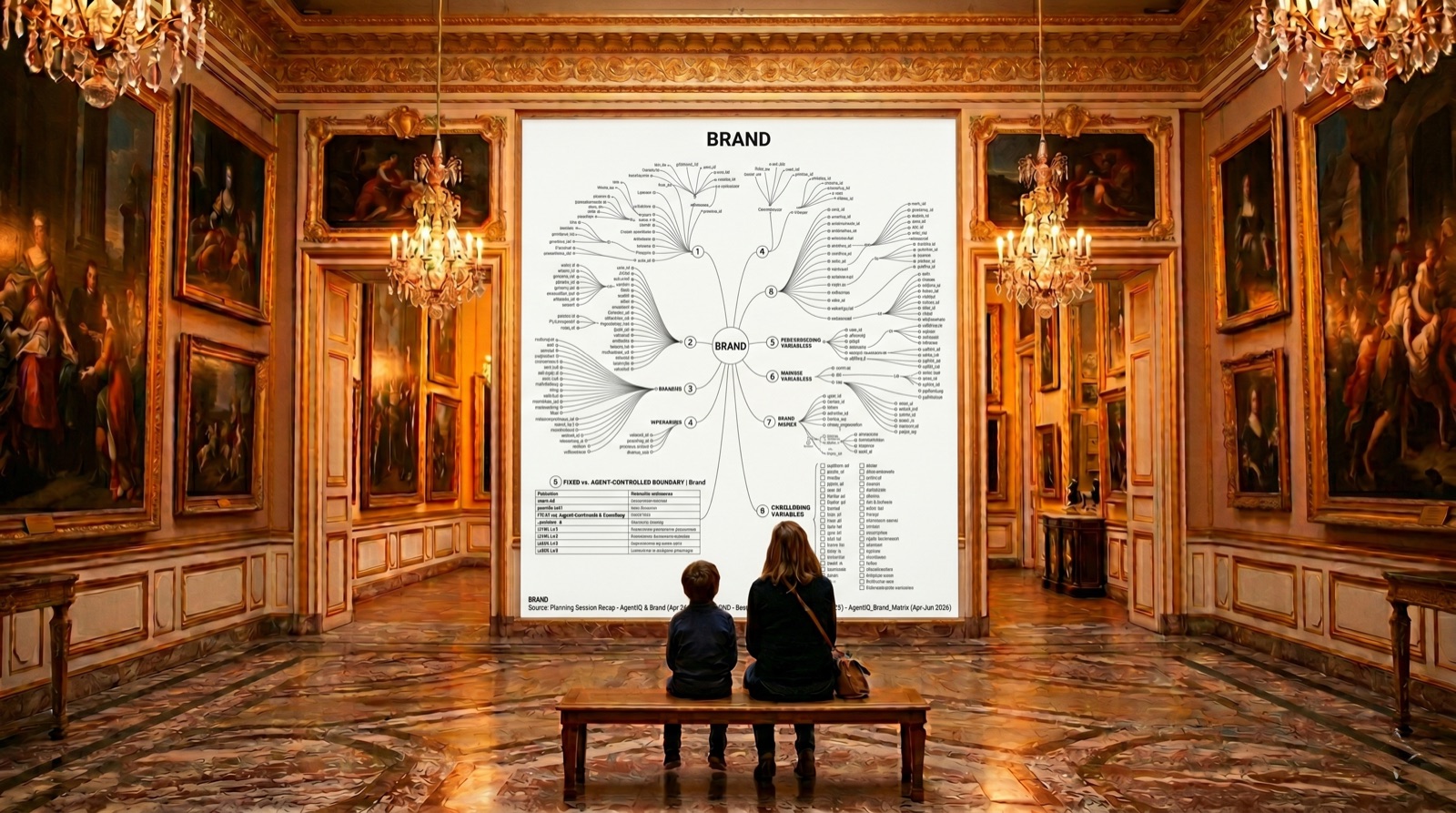
The Discipline of Rejection: Winning AI Trust by Saying "No"
In the traditional world of e-commerce, we were taught to be people pleasers. We spent decades perfecting "brand storytelling" and inclusive copy that made everyone feel like our product was for them.
But the rules have changed. We are entering the age of Agentic Commerce, where the primary "shopper" is an AI agent. By late 2025, surveys showed that 74% of young adults were already using AI chatbots for daily tasks, including product discovery. At 40rty, we are leading the charge into this era, and our research shows that to get an AI agent to choose you, you have to tell it who your product is not for.
The Problem: Ambiguity is the Enemy
When a human shops, we use intuition. AI agents, however, are mathematically programmed to be risk-averse. They exhibit significant Ambiguity Aversion, a statistical preference for known risks over unknown probabilities.
Recent tests prove how much this matters:
- The Confidence Gap: In decision-making trials, AI models using ambiguity-averse logic produced 14.97% high-confidence recommendations, while models faced with vague data produced 0%.
- The Skipping Effect: When an agent cannot verify a "fit," it treats ambiguity as a risk signal. If your data is too broad, the agent simply skips your listing to protect the user's experience.
The Solution: "Negative Optimization"
This is the "aha" moment for product data. Negative Optimization is the strategy of using explicit disqualifiers to remove risk for the agent. By defining your boundaries, you create Verified Trust.
The data proves that being specific about what you don't do actually improves your performance:
- The Precision Jump: In technical benchmarks (Llama-3.1), increasing the strength of "negative constraints" caused the model's operating precision to jump from 17.6 to 49.9.
- The Discriminative Power: Research shows that removing "hard negatives" (data points that look like a match but aren't) actually causes AI performance to drop from 77.60% to 76.26%.
The business strategist Michael Porter famously said, "The essence of strategy is choosing what not to do." In the Agentic Age, the essence of product data is choosing who not to sell to.
How 40rty and AgentIQ Set the Standard
At 40rty, we have built this "discipline of rejection" into our AgentIQ technology. We help merchants move beyond the visual layer to provide the "Proof over Persuasion" that agents require.
- Verified Results: Merchants using our agent-ready catalog audits see 2–3× more products chosen by AI agent shoppers.
- Building a Context Graph: We don't just list a price; we structure your data so agents can "reason" about why your product is a perfect fit for one persona and a poor fit for another.
- Protocol Readiness: We ensure your store is compatible with the Universal Commerce Protocol (UCP), the new open standard that allows agents to complete a purchase directly within a chat.
The Takeaway: Winning the Trust of the Machine
AI agents are looking for the "Perfect Fit," and a perfect fit is impossible without defined edges. By being brave enough to say "No" to the wrong customer, you become the only logical "Yes" for the right one.
In the Agentic Age, the most profitable statement your brand can make is a clear, data-backed disqualifier. That is how you win the trust of the machine and the future of commerce.
Want to learn how strategic rejection can improve your AI commerce performance? Talk to our team
Sources
- Cognitive pitfalls of LLMs: a system for generating adversarial samples based on cognitive biases - SPIE Digital Library, accessed February 5, 2026
- Sparks of Rationality: Do Reasoning LLMs Align with Human Judgment and Choice? - arXiv, accessed February 5, 2026
- Understanding and Mitigating Over-refusal for Large Language Models via Safety Representation - arXiv, accessed February 5, 2026
- OR-Bench: An Over-Refusal Benchmark for Large Language Models - arXiv, accessed February 5, 2026
- The Automaton Economy: AI Agent Strategic Framework | Paul F. Accornero - The AI Praxis, accessed February 5, 2026
- Beyond the Basics: Advanced Prompt Engineering Techniques - DEV Community, accessed February 5, 2026
- What Content Types Build The Most Trust? - Torro Media, accessed February 5, 2026
- 6 Reasons Why Your GTM Strategy is a Dumpster Fire - accessed February 5, 2026